


Skin
✦
✦
7 min
SkinVive, fillers, or a facial: how to tell what your skin is asking for
By Sofia Syed, MSN, FNP

Patients rarely arrive asking for a product. They arrive describing a reflection. "My skin looks tired." "My cheeks flattened out." "Makeup sits in it now." Each sentence points to a different depth of treatment, and depth is the organizing idea worth keeping: the surface, the layer just beneath it, and the architecture underneath everything.
The surface is where facials and superficial peels work, on dead cell buildup, congestion, and rough texture. The evidence here is older and modest in size but genuinely controlled. In a double-blind, vehicle-controlled split-face study, four weekly applications of 50 percent glycolic acid measurably improved rough texture and fine wrinkling, with skin biopsies confirming a thicker, healthier epidermis. Surface work shows quickly and fades as skin renews, which is why it behaves more like a subscription than a purchase. A HydroDiamond facial or a peel series is maintenance in the truest sense.
One layer down lives SkinVive, and it is the newest evidence on this page. The FDA approved it in May 2023 as the first hyaluronic acid microdroplet injectable for improving cheek skin smoothness. In its randomized, evaluator-blinded pivotal trial, 58 percent of treated participants improved by at least one grade on the validated cheek smoothness scale at month one, and 56 percent still held that improvement at month six. Its mechanism is water: hyaluronic acid binds moisture within the skin itself, and in laboratory skin-explant work the same gel raised measured hydration by roughly half within eight days. The result reads as glow rather than lift. If you want visible lift, SkinVive is the wrong tool, and I will say so at the consultation.
The deepest layer is structural, and that is filler territory. Hyaluronic acid fillers are Class III medical devices, the FDA's most scrutinized category, and they restore the volume that time redistributes: the cheek that deflated, the fold that shadowed, the lip border that blurred. The FDA describes their effects as lasting six to twelve months or longer, and some products carry longer study data in specific areas. At our practice fillers start at $775 a syringe, quoted precisely after an exam.
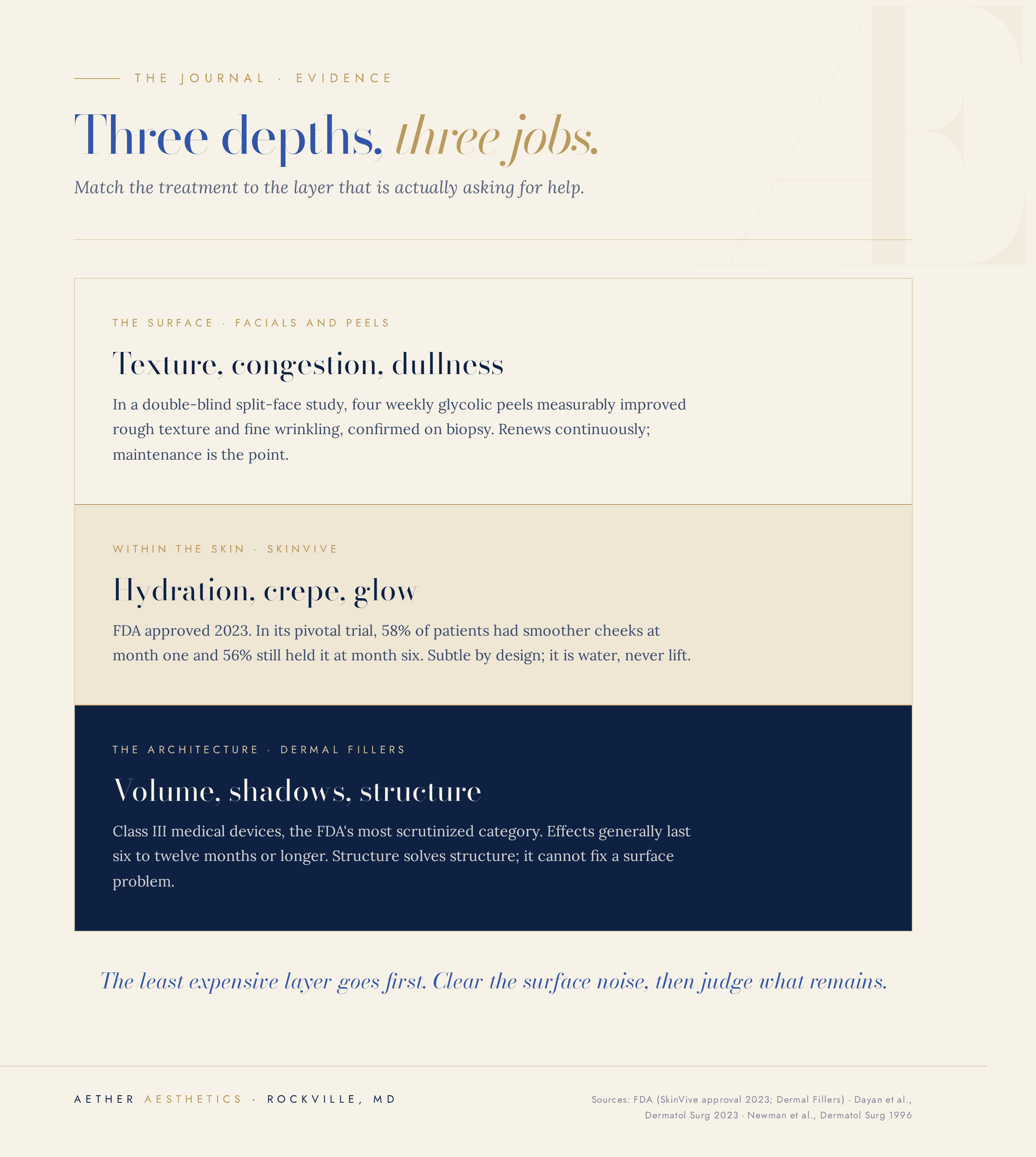
Now run the logic backward from your mirror. Skin that photographs dull but still sits where it always did is usually a surface problem first. Skin that looks parched in a way moisturizer never fixes, with fine crepe across the cheeks, is the SkinVive conversation. A face whose shadows have moved, where light lands differently than it did in photographs from five years ago, is asking about structure.

The order I suggest often surprises people, because the least expensive treatment usually goes first. The reason is diagnostic. Texture and dehydration mimic volume loss under bathroom lighting, and filler placed to chase a surface problem produces the overfilled look everyone fears. Clear the surface noise and the real question gets easier to answer, sometimes cheaper too.
Can the three combine? Constantly, on different clocks: facials on a six-week rhythm, SkinVive refreshed around the six-month mark its trial supports, filler assessed annually. Building that calendar for one particular face is what the consultation is for. Bring your five-year-old photos. They settle more arguments than I do.

Sources
FDA approval of SKINVIVE by Juvéderm, May 15, 2023; pivotal trial (Dayan et al., Dermatologic Surgery, 2023: 58%/56% responder rates at months 1 and 6) · VYC-12L ex vivo hydration study, Plast Reconstr Surg Global Open, 2020 · FDA, Dermal Fillers (Class III designation; 6-12 month duration) · Newman et al., Dermatologic Surgery, 1996 (50% glycolic acid split-face study)

Modern Luxury.
Timeless Beauty.
Visit
Rockville, MD 20850
Mon–Fri · 11:00 am – 7:00 pm
Saturday · By appointment